Thursday, January 10, 2008

On the classification of events


I am returning to the area of "classification of events", although it has been discussed in this blog several times regarding certain aspects, the reason is - some discussion in which I realized that the confusion is still alive and kicking.
Events can be classified according to their structure, semantics, or pragmatics. This classification is orthogonal.
Based on Structure:
  • Simple or atomic event - an event that reports on a single occurrence.

The event structure may be flat (like relational database), or semi-structured (XML) - which also can express non-flat structure (e.g. hierarchical). In some cases events are represented as objects. Typically events contain "header" - information about this event (event class, time stamp, source...), and "payload" - the content of the event.

  • Complex event - an event that is composed of multiple events

There is some difference between this and the term "composite event" from active databases which mixes structure and semantic aspect, but I don't see it useful to use this term any more.

Based on source

  • Raw event: Event that has been reported to the event processing system by an external event producer.

Note that a raw event can be simple or complex. The term "raw" is relative, since it can be result of some computation process in the event producer that is transparent to the event processing system.

  • Derived event: Event that is created by the event processing system as a result of some processing.

Again, the derived event can be simple/atomic - where the attributes are computed as functions of raw and derived events, or complex - in which the derived event is a concatenation of events.

Based on ontology:

  • Real event: An event that designates something that occurs in reality
  • Virtual event: Hypothetical, simulated or uncertain event.

Again, this is a separate dimension - can be in any structure and by any source.

Based on pragmatics

  • Reactionable event (AKA situation): An event that is consumed by an external consumer at the end of the event processing network (either notify or orchestrate).

We used the term "situation" for a phenomenon in the consumer's domain of discourse that the consumer wishes to react to. This can be raw event (and in this case the event processing system is reduced to "simple event processing" - i.e. filtering and routing) or derived event, it can also be real or virtual, and in any structure.

BTW - ECA - "Event-Condition-Action" rules are rules in which the events are situations, and they are executed within the consumer domain, but I'll continue to discuss the conceptual model in the next posting.

Tuesday, January 8, 2008

On the Event Processing Conceptual Model


The event processing conceptual model shown above is a result of a work by an IBM internal team lead by my colleague Mamdouh Ibrahim. I have presented it in the "reference architectures" session of the last EPTS meeting, we have decided not to use the term "reference architecture" since it has multiple implementations, but this represents the different parts of an event-based applications. The three major building blocks are - event prodcuers, event processing network, and event consumers.
  • Event producers - emit events in push or pull (periodic or on-demand).
  • Event Processing Networks - process the events, create derived events where applicable, route the event to event consumers at the edge of the network
  • Event consumers - consume the processed events and orchestrate/notify.

As you can also see the event processing network has two bridges - one to the producers and another one to the consumers, in which several of the functions of the EPN may reside.

We believe that this is a general enough conceptual model that can contain various variations.

Note that the "event processing network" requires an "event bus", this is a platform-independent term - in SOA environment - as noted in a previous posting the "event bus" converges with the "enterprise service bus". More deep description of the different ingredients - in later posts

Sunday, January 6, 2008

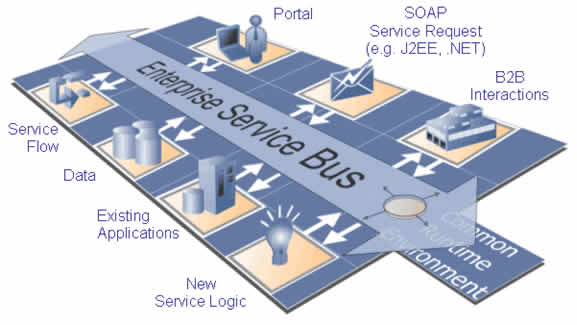
On Enterprise Service Bus and Event Processing


This is one of the variations of Enterprise Service Bus (ESB) illustrations that I have taken from an article by one of my IBM colleagues. The topic of today is -- what are the relations between ESB and Event Processing ?
  • An event processing functionality that runs Event Processing Agents in various sources, requires a that will take care of the routing and execution in a distributed environment. There are three alternatives here:
  1. No native platform -- an engine that can run in multiple platforms (thus need to be integrated to each platform that it runs in by adapters etc...).
  2. Dedicated event processing platform -- the event processing part has a dedicated platform that provides the infrastructure for the event processing functions.
  3. Event Processing is built as part of an already existing platform.

All of these variations exist in the market today, and there are pros and cons for each of them, smaller vendors may prefer the first alternative as my friend Marco noted in his Blog.

When getting to the third alternative, if the environment is a SOA environment, then the ESB is a natural place in the SOA middleware to be the principle carrier of event processing functionality:

  • It provides messaging infrastructure and routing capabilities
  • It provides mediations like - validation, transformation and enrichment that can be reused for event processing (have a large intersection with the "mediated event processing" functions)
  • It supports distributed environment.

While the principle usage of ESB in SOA has been to mediate between consumer and producer of services, being a carrier for event processing is now considered as a step in the evolution of ESBs.

This does not say that ESB is the ONLY place in which event processing functionality can run, which brings to a discussion about the Event Processing Conceptual Model- which I'll deal in a subsequent posting.

The ESB gets into the picture in alternative

Saturday, January 5, 2008

On Trifecta and Event Processing


Reading the educated blog of my friend Tim Bass
I had to admit that I don't have any clue what a "Trifecta" is, and rushed to wikipedia
for help to find out that in horse races - it is a bet on the first three horses. I must confess to my ignorance - I have never watched a horse race, neither have I gambled on horses. I have made a major technological gamble though, around 10 years ago, to bet around "complex event processing" (without using this name and without knowing on the three others who have worked in parallel on the same topics - will have at some point postings about the history), and after suffering some frustration periods, it seems that the reality also slowly getting there, and I still hope it will be the "next big thing" - but we have some work to do in order to get there -- again, a topic for another posting. Now the question posed both by Tim Bass, and by Joe McKendrick
is - whether CEP is depended on SOA, and in turn - does it require the coupling of SOA and BPM - which is by itself a problematic concept.
My answer is -- CEP is an horse that is indepdent in any other horse, donkey, mule or tiger. As I noted in earlier postings, SOA and EDA are orthogonal - SOA is about modularization or componentization of the enterprise, and hence it IT systems, introducing modules as "services". Now let's talk about the relations between SOA, CEP and BPM.
(1). Services in SOA can be producers and consumers for "Event Processing Agents"; as a producer - the service is instrumented to emit events, as a consumer it can be notified or triggered by an event; Services are one type of consumers and producers but not the only type - every application can be consumer or producer, thus there is a loose coupling.
(2). In SOA environment there is an ESB (Enterprise Service Bus), whose functions have some overlap with event processing (especially mediated event processing) - can be a natural host for the "event processing network" (I'll write more on ESBs in another posting). However, again Event Processing Agents can also run outside ESB.
(3). Workflows (BPM) are special type of consumers and producers. In the SOA world, BPM orchestrate services, and thus, BPM can emit events about the status of the workflow, while as a consumer it can add/modify/delete one or more workflow instances. Some of the Event Processing applications (e.g. some types of BAM applications) are based on business processing - however, even in SOA environment this is only one type of consumer and producer, and there are other types (e.g. RTE applications which process events in-line and not in observation mode).
Bottom line --- Event Processing can have different interactions with SOA, and when IBM's announcements in this area will be available you'll realize that there are different entry points. Event processing can also work in legacy and non-SOA environment.

So today I have learned about horse races and promised some more postings (not promising when) -- more, later.

Thursday, January 3, 2008

IBM WebSphere CTO sees CEP as SOA's 'next big thing'


In Israel there are sometimes news items that are forbidden by the military censorship, but if broadcasted by foreign sources - one can quote the foreign source and broadcast it in Israel.
I have not referred in this blog to IBM plans in this area, since they have not announced yet by the proper channel, but I may quote the interview with IBM Websphere CTO, Jerry Cuomo
in which he stated that he sees CEP as SOA's next big thing -- and promised both new technology and additions to existing ones. Stay tuned for more information on IBM and Event Processing.

Monday, December 31, 2007

Has BAM failed ?


Last posting in the year 2007 - we don't celebrate new year as an holiday, but since the civilized world is using the Gregorian calendar and not the Hebrew calendar we tend to celebrate holidays according the Hebrew calendar and do everything else by the Gregorian calendar.
Anyway - this posting is another in the series of responses to Colin White's article. This time I'll refer to one sentence in that article: This is somewhat analogous to the way business activity monitoring (BAM) solutions were developed independently from the existing business intelligence environment. BAM failed, and the solution was to instead build embedded BI applications that supported the concept of BAM, but which also were integrated with traditional BI processing. The claim is simple:
  • The sin - BAM solutions were developed outside the true religion of BI;
  • The punishment - BAM failed;
  • The redemption - Embedded BI applications have included the concept of BAM -- and lived happily ever after.

In order to analyze this claim - let's first define what "BAM solutions" are. BAM - Business activity monitoring (or management) stands for a class of applications that observe the behavior of business activities (business processes, transactions, applications etc..), in a non politically correct terminology (well, we are lagging behind USA, we have not invented political correctness yet) I can call it "the big brother is watching", a term that is sometimes used is "observation" - the essence is -- look at business activity from the outside, and try to find situations that are of interest - can be major situations like - threats and opportunities, but most of them are micro issues that need to be observed, maybe fixed, maybe just watched closely.

Now for the question of failure or success -- Bill Gassman from Gartner claims in his talks that 65% of the BAM solutions are industry specific, and general purpose software accounts only to 35% of the BAM solutions. Indeed, while the notion of observation is general, what we would like to observe and how is very much domain dependent. Performance management that trace Key Performance Indicators is one flavor that has been generalized, but many of the BAM solutions are not about tracing aggregates or measurements, but about tracing individual situations in the business activities: delivery has failed, to meet the deadline, customer has complained and not handled well, medical treatment has been done outside the protocol for that disease - there are examples from all industries for it. Event Processing is a useful technology in cases where the BAM solution is event-driven, and its input is event. Some of the BAM situations are detected on-line, some of them are detected in retrospect - and I'll talk about retrospective event processing in another posting. General BAM systems are useful for some cases - and are less useful for others.

So - my 2 cents opinion about Colin White's claims:

  • The concept of BAM has not failed - there are many success stories, however the area has not reached maturity. General purpose BAM are effective for some of the BAM market, but many BAM solutions are more industry-specific -- event processing is useful both for the general-purpose BAM market and for the industry-specific BAM market.
  • And as for BAM on top of BI -- according to Gassman this accounts for 10% of the BAM solutions market, so while it has certainly its own variety of application, the majority of the BAM market is not a BI market.

P.S - the picture above is of a skateboard called BAM -- and I hope it sells well - click for a free advertisement to skateboards

More - Later.

Sunday, December 30, 2007

Event Processing for Business Intelligence


From the various descriptions of Business Intelligence found on the Web, I have chosen the one by Hakki Erbug as a starting point.


As noted in several previous postings, IMHO, event processing is a set of technologies that have multiple usages, and are not really strongly associated with a single type of application. Business Intelligence is similar in the fact that it combines various technologies, but different in the fact that it is focused around area of using data for decision making in various ways. In the event processing case, decision making is one of the possible usages, but not the only. This posting will briefly survey how event processing can enrich business intelligence, and in fact, in the Gartner EPS summit I have seen several BI vendors that are looking at EP as a natural capability to complement their products.


Going on Erburg's illustration clockwise:


1. "Active Data Warehouse" - While traditional warehouses are being updated in batch, the notion of active data warehouse makes the warehouse update itself an event-driven action. The rationale is: when a certain event (raw or derived) occurs, a decision has to be taken, however, the decision relies on a data warehouse, thus, an update of the data warehouse should occur before making this decision. The update can be of the same event that happens or of some collection of data that has still not been updated in the data warehouse and is needed for the decision making. There can be some time constraints associated with the decision (and in turn with the warehouse updates). The time constraints are not necessarily micro-seconds, the constraints can be minutes or hours, but they are typically well-defined.

2. ETL and mediated event processing: ETL has some functional similarity with mediated event processing, it is also about transformation. We see mediated event processing and ETL getting closer to one another, where difference may be in quality of service. In the future there may be a case that ETL will become a specific case of mediated event processing (of course ETL folks may say the same from the opposite direction).

3. Real-time analytics: While analytics (simulation, optimization, mining...) has been used for a while in the decision making part of BI, in the event-driven world, the reaction to an event in some cases is temporally-bound, which means that there is a real-time constraint, or upper limit on the requested reaction time. This provides new way of thinking about analytics - while without time constraints an optimization should strive to get the "best result" (or if heuristics satisfy some approximation condition), in real-time analytics the optimization strives to get "the best result that can be obtained in T time-units as specified (e.g. 18 seconds)". How does event processing play in real-time analytics? it may play in a simulation mode - scenarios are created and simulated events are emitted - they in turn may create simulated derived events which determine the situations of this simulation. This is, of course, in addition to the fact that in an event-driven universe, the entire BI cycle is event-driven and relates to the event and its context.

To conclude -- event processing is a natural step in the BI capabilities, and thus I expect BI suites to support the event-driven flavor... This - again, does not say that BI is the ONLY use of event processing. I still need also to refer to the issue - "has BAM failed because it was not based on BI techniques" as claimed in the article that triggered my discussion on the BI topic - stay tuned.