Showing posts with label IBM. Show all posts

Monday, August 11, 2014

Book review: The Decline and Fall of IBM


Since I spent more than 16 years in IBM, I read with interest a small book authored by Robert Cringley, a journalist that has investigated the insides of IBM during the last few years. The title is a paraphrase on the famous book: "The decline and fall of the Roman Empire", and indeed when I was young and IBM dominated the IT market it looked like the Roman Empire from the outside.  Cringley starts by surveying IBM's history , getting to Lou Gerstner period where he saved IBM for a while,  while he mentions the good things that Gerstner did for IBM he also mentions some of his mistakes:  building competitive services arm using cheaper labor, which deteriorated the quality, the second mistake is selling the networking business to AT&T, and the biggest mistake according to Cringley is nominating Sam Palmisano to be his successor.

His main criticism is indeed addressed at Palmisano by taking the "shareholder only" approach to extreme (I have written before about the shareholder value myth).  Maximizing the shareholder value, and the "2015 roadmap" making the $20 Earning Per Share as the only game in town.  Kringley claims that by doing it IBM became a cash cow,  Meeting the 2015 roadmap involves financial engineering, such as spending $101 Billion dollars on buying back around third of its shares, inflating the value artificially, moreover, IBM does it with borrowed money.  The problem is not only the financial aspect, constants cutbacks in workforce hurt the quality of service of IBM to customers, and IBM suffered various contract cancellations. He also criticises the HR aspect, IBM is calling its employees "resources" and the workforce reduction is called "resource action".   My note:  once when I worked in IBM we had a meeting of HR director from the USA with all manager, and when she kept talking about people as "resources", one of my colleagues remarked that in the Israeli culture is considered as a big insult, like calling person "it" in English. She tried her best to use the term "people" or "employees", but it was difficult for her, since she really thinks on people as resources, however, people don't like to be treated as resources, and the current policies create a dissonance between the upper management and many employees. Finally he analyzes the areas where IBM is active:  hardware, software, services, analytics, mobile and cloud, analyzes IBM problems in each of the area, and talks about possible solution.    The author's conclusion is quite pessimistic for the future of IBM unless the current CEO Ginni Rommety will make fundamental changes.  He also brings a lot of letters from insiders to reinforce his opinions.

As a veteran IBMer, many of the things he talked about were familiar to me.  I am not qualified to judge IBM strategy,  but there is a general sentiment  among many people inside IBM that is consistent with his conclusions.  However, I believe that IBM which survived more than 100 years will survive this, but probably it will need another Gerstner-like person to get it out of the box it is now...  

Sunday, May 26, 2013

More on fraud detection from IBM - the MoneyGram case

I have recently written about real-time fraud detection solution from IBM based on SPSS and CICS. 
Another solution from IBM in the fraud detection space has been recently highlighted by David Luckham in his site citing a Forbes article.   This solution is based on the "Entity Analytics" solutions (specifically the Infosphere Identity Insights product.    David Luckham comments "that are a lot of CEP under the hood of  this stuff".  This is true.    After the acquisition of SRD by IBM, our team in IBM Haifa Research Lab helped integrating our work on Amit as embedded part in the Entity Analytics -  (see the DEBS 2010 presentation by Ella Rabinovich on Industry Experience with Amit - slide 3).   This integration seems to have survived all these years and being employed for useful purposes. 

In any event,  there are many solutions in which event processing is integrated with other technology to create specific solution, and we can see alliances between event processing technology and other technology in this area.

Thursday, June 16, 2011

IBM celebrates 100 years

Today, June 16, IBM celebrates its centennial.    It is an achievement to a person to get to 100 years, but also to an organization.    There is a famous book: Built to Last, that talks about companies the lasts for many years.  IBM is in this list along with American Express, Boeing, Disney and some others.  You can view the IBM centennial site. 

Monday, October 25, 2010

On the IBM Corporate Award - recognition event

Yesterday, there was a "recognition event" to recognize those in Israel who received the IBM Corporate Award, and some other awards this year. This award is the highest award that IBM grants to its employees, this year there have been 20 such awards worldwide (IBM employees from Israel have participated in 3 out of these 20 awards - quite an achievement relative to Israel size inside IBM), where each award can be shared among several people.    In the picture above you can see me in the middle between Meir Nissensohn, the General Manager of IBM Israel on my right hand side, and Oded Cohn, the Director of the Haifa Research Lab, on my left hand side.   Actually I got this plaque more than 2 months ago, and handed it over so I can get it back on the stage.  The award was given for "deep insights and groundbreaking research in Event Processing",  and contribution to the event processing industry development in general to be an emerging market, and getting IBM as a leader in this area in particular.


Then they asked me to provide some impressions 


We were briefed beforehand and were told that we'll not be able to use slides, just use voice, so I have given some insights and impressions in a way that was described later by people as a "stand-up performance" (well, I was sitting down), this is consistent with one of my old habits - Ridendo Dicere Verum,  when we started working on event processing in 1998, we did not know that we are doing event processing, we did not actually used that name, we also did not realize that 10-12 years later it will be an established and well-recognized area.   Getting new ideas in a big corporate are never easy, and I have written before about some best practices to navigate.    


Getting a recognition is always fun - but as my motto in life is based on the poem "IF" by Kipling, I'll end with one citation from this immortal poem:


If you can meet with Triumph and Disaster
And treat those two impostors just the same;


This award has reflected past work, but the challenge for the present is to work on the future of this area, my recent talk in the OMG conference reflects some of the work towards the future.

Sunday, May 24, 2009

On System S


The logo above (in Hebrew) is the logo of the academic college of Emek Yezreel , in which I am serving in the steering committee of the Information Systems department, which is a new department started this year, as part of my service to the community, I am helping various institutes to establish academic plans to give the opportunity to people that otherwise would not be able to acquire academic education. As Aliza Shenhar, the dominant president of this college has said: for many of the students they are the first in their family ever to obtain academic degrees. We had an interesting discussion about the challenges that they have in teaching a diversified population.

Anyway, today I would like to write a little bit about System S, which has been recently highlighted by IBM, and been covered in NY Times, ComputerWorld, and some of the community Blogs by Paul Vincent and Marc Adler. The picture below, taken from the NY Times show Steve Mills, the head of IBM Software Group (on the left hand side), and John Kelly, the head of my organization, IBM Research (on the right hand side), both senior vice presidents in IBM, reporting directly to the CEO.


So what is System S, and how does it relate to event processing ? In the slide that Steve Mills points at, the title is "Stream Computing", and indeed, this system takes streams in the broad sense, anything that sends constant information from various types -- such as: video, audio, text, multi-media. The points in this slide are showing a data flow, and indeed, System S is a platform that can run data flow of processing elements in the system S terminology, each of them runs on stream of a certain type, and provide some form of analytics -- filtering, aggregation, extracting features out of video, interpreting voice and much more. The platform can take advantage of supercomputers to provide parallel processing, and digest high throughput of data. You can read more about it in the IBM Research website (I am not sure it is up to date). System S is a prelude to an IBM product already announced under the name -"Infosphere Streams".

Now, the question is what is the relationship between System S and event processing ? There are two different points. The one is that System S can take as an input large amount of streaming data, filter and aggregate it, and create a relatively small collection of events that can further be processes by some event processing engine. The other is that System S, as said, is a platform; the processing elements in this platform can be, in principle, event processing agents. In fact, while the semantics of the data flow is not identical to the semantic of an event processing network, it is possible to map event processing network to be implemented by the System S platform. The spade language provides some such capabilities, and may be extended in time to include more. IBM takes a portfolio approach to event processing (BTW - IBM does not use the "CEP" TLA, it uses its own TLA "BEP" as Business Event Processing, I tend to use event processing without prefixes and suffixes, as I stated before), since it believes that the "one size fits all", does not work, due to differences in functional and non-functional properties. System S is definitely aimed at the high end, in terms of throughput requirements. More - Later.

Thursday, January 15, 2009

Welcome the ILOG team to the blue giant


Recently, the acquisition of ILOG by the blue giant (IBM, the company who pays my salary) has been completed.
It was interesting to read the InformationWeek article which had event processing in the title of this article.

ILOG is, of course, well known for its business rules product ( I had some history in this area in my past...).

There are various relationships between business rules and event processing technologies, and there are also various opinions about the various relationships.... I have blogged a year ago about this issue.

While I looked at business rules from EP perspective, Some ILOG guys also investigated the opposite direction, in the last EPTS meeting we had met Pierre-Henry Clouin, who blogged about it , prior to the EPTS meeting. Now we can continue the short discussion we had in Stamford .

Another ILOG guy who had a guest posting about EP issues is Changhai Ke.

Joining a big corporate is certainly a cultural change (shock for some), but also opens some horizons, so I wish Pierre-Henry, Changhai and the rest of the ILOG team a smooth transition and we'll certainly meet in one of the blue corridors.... Welcome on board.

Thursday, April 10, 2008

On Impact 2008


This is the MGM Grand Hotel and Casino in Las Vegas, the place that hosts this week the IMPACT 2008, a very big customer conference of IBM Websphere (more than 6000 persons).


The hotel is huge, the logistics is very good, and the program is very diversified. James Taylor described the two first days in his Blog . One of the main themes in this conference was the issue of business event processing, IBM's product Websphere Business Events, was announced last week. Today I have given a talk on the concept of "business event processing" together with my colleague Steve Lyons (a former Aptsoft guy), thus I have done my share. This was well covered by the press. The main message behind it is enabling the business user to control the behavior (e.g. define patterns) of EP applications, this concept won a lot of interest from the IBM clients that were present.


On another matter - congratulation to Mark Palmer for his new position in Streambase, Mark is definitly one of the notable figrue in the EP area.

Sunday, March 30, 2008

Moving to a new job - but actually staying in the same office


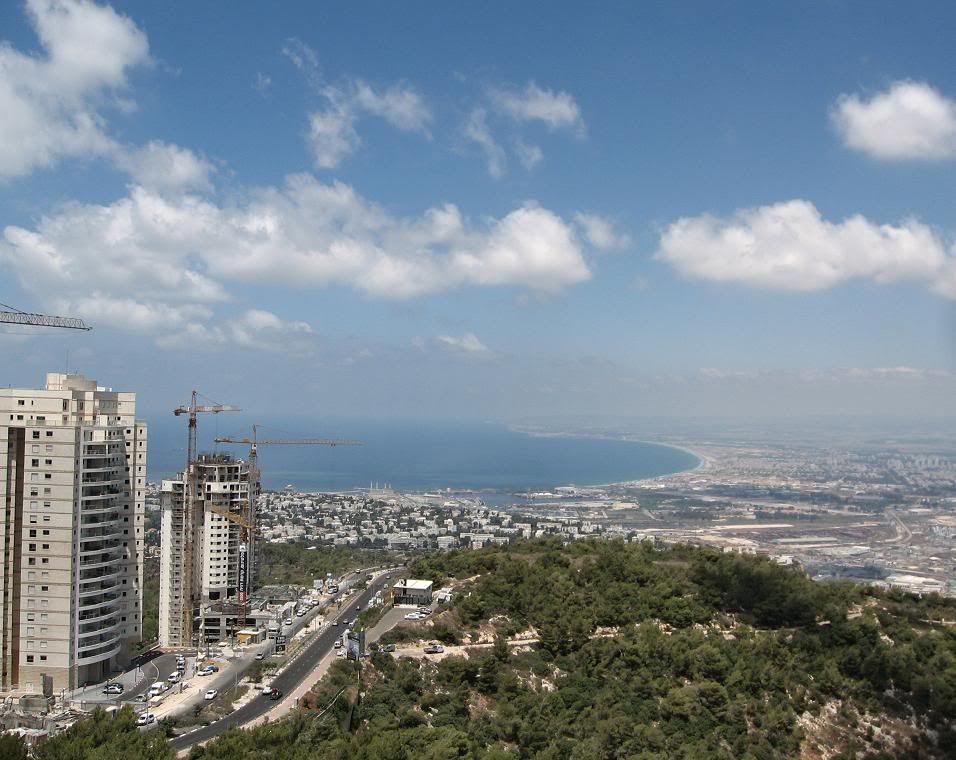
This is part of the Haifa Bay as seen from the IBM building (not from my office - I am in the back side!). On April 1st I am moving to a new job - without physically moving office (which means that I am still in IBM).

What role I am completing ? in the last three years I have been in a technical strategy role for the IBM Websphere product organization.
I have arrived to the product organization when people there did not really know much about "event processing" (well, IBM has done some forms of event processing in the past, but the people inside IBM did not think of that this way), I have worked on technical strategy, and business strategy, chairing and participating in workgroups, worked on business evaluation with the business side of IBM, working on comprehansive requirement survey in multiple industries, participating in many reviews, preparing answers for skeptic people etc.. I am leaving this position in a state that IBM sees event processing as part of its main stream middleware (as evident in the acquisition of Aptsoft, and some other activities), and as the next big thing.
Of course, the relationships between my presence and IBM's decision to jump on board the event processing ship may be just a coincidence...
Anyway - it seems that the next challange for me will be in shaping the next generation, while I still be somewhat involved in the work on the current generation.
One of my findings is that the "event revolution" has not occured yet, and I would like to go back to the drawing board, and do some work to address some fundemental challanges. In order to concentrate on this goal, I am re-joining to the IBM Research division and will focus on these research challanges (hopefully without many interruptions, each organization collects its own taxes on one's time, and IBM Research is no different ). What has not changed ? I am continuing to represent IBM in the EPTS and will honor all external commitments.
Stay tuned for call for membership in EPTS - coming this week.

Wednesday, January 23, 2008

Welcome to the AptSoft team to IBM


Burlington, Mass. - I have never been there - but I have learned from its official website that they hold town meetings which is nice. Besides town meetings, it is also the home of the AptSoft company. Today it was announced that AptSoft has gained a new home and becomes part of the IBM Websphere organization. Getting from a start-up to a big company is a big step (I have been in both types of organizations and know the difference...), and sometimes a caltural shock... it is also a big step for those who believed that IBM should be a player in the CEP space,
making the first announcement about complex event processing product with this acquisition.

While I still need more education about the AptSoft product, it seems on first impression (what I have seen in the Gartner EPS conference in their booth) that they have a thinking competible with what I posted about the fact that CEP patterns should be defined, in many cases, by a business user and not by a developer, and their thinking is geared towards this direction -- this is a good value that they bring to the table.
Meanwhile -- to Steve Lyons, David Martin and the rest of the AptSoft team - warm welcome to IBM, and happy blue-washing... see you around in the corridors of the blue giant.

Saturday, January 5, 2008

On Trifecta and Event Processing


Reading the educated blog of my friend Tim Bass
I had to admit that I don't have any clue what a "Trifecta" is, and rushed to wikipedia
for help to find out that in horse races - it is a bet on the first three horses. I must confess to my ignorance - I have never watched a horse race, neither have I gambled on horses. I have made a major technological gamble though, around 10 years ago, to bet around "complex event processing" (without using this name and without knowing on the three others who have worked in parallel on the same topics - will have at some point postings about the history), and after suffering some frustration periods, it seems that the reality also slowly getting there, and I still hope it will be the "next big thing" - but we have some work to do in order to get there -- again, a topic for another posting. Now the question posed both by Tim Bass, and by Joe McKendrick
is - whether CEP is depended on SOA, and in turn - does it require the coupling of SOA and BPM - which is by itself a problematic concept.
My answer is -- CEP is an horse that is indepdent in any other horse, donkey, mule or tiger. As I noted in earlier postings, SOA and EDA are orthogonal - SOA is about modularization or componentization of the enterprise, and hence it IT systems, introducing modules as "services". Now let's talk about the relations between SOA, CEP and BPM.
(1). Services in SOA can be producers and consumers for "Event Processing Agents"; as a producer - the service is instrumented to emit events, as a consumer it can be notified or triggered by an event; Services are one type of consumers and producers but not the only type - every application can be consumer or producer, thus there is a loose coupling.
(2). In SOA environment there is an ESB (Enterprise Service Bus), whose functions have some overlap with event processing (especially mediated event processing) - can be a natural host for the "event processing network" (I'll write more on ESBs in another posting). However, again Event Processing Agents can also run outside ESB.
(3). Workflows (BPM) are special type of consumers and producers. In the SOA world, BPM orchestrate services, and thus, BPM can emit events about the status of the workflow, while as a consumer it can add/modify/delete one or more workflow instances. Some of the Event Processing applications (e.g. some types of BAM applications) are based on business processing - however, even in SOA environment this is only one type of consumer and producer, and there are other types (e.g. RTE applications which process events in-line and not in observation mode).
Bottom line --- Event Processing can have different interactions with SOA, and when IBM's announcements in this area will be available you'll realize that there are different entry points. Event processing can also work in legacy and non-SOA environment.

So today I have learned about horse races and promised some more postings (not promising when) -- more, later.

Thursday, January 3, 2008

IBM WebSphere CTO sees CEP as SOA's 'next big thing'


In Israel there are sometimes news items that are forbidden by the military censorship, but if broadcasted by foreign sources - one can quote the foreign source and broadcast it in Israel.
I have not referred in this blog to IBM plans in this area, since they have not announced yet by the proper channel, but I may quote the interview with IBM Websphere CTO, Jerry Cuomo
in which he stated that he sees CEP as SOA's next big thing -- and promised both new technology and additions to existing ones. Stay tuned for more information on IBM and Event Processing.