Showing posts with label academic programs. Show all posts

Thursday, July 12, 2012

The professor's hat

Sometimes people ask me what hat am I wearing now, since I have a reputation of wearing several hats and sometimes switching hats in the middle of a sentence.   

Today I added additional hat - the professor hat.      How did I get this hat?  -- 
around a year ago I was asked to serve as academic adviser to the MIS department in the Yizreel Valley College,  I decided to do it, on top of all other things I am doing, as a kind of contribution to society, contributing to higher education in the periphery, the college resides in a green area in the countryside, around 45 minutes drive from Haifa (depends on the traffic).


 I supervised students seminars and projects, and started a work on help re-design the curriculum.  I have been teaching over the years at the Technion as adjunct faculty member,  but in the college I am in the status of a "real" faculty member (part-time), so I needed academic appointment.   To anybody not familiar with academic processes - academic appointment procedures are inherently long, go through multiple phases, with non-deterministic results, the nominee is totally passive and does not know (unless somebody leaks) who is evaluating, and what the status is.

Since the process is long, I started with temporary appointment, and the process started.   
Today the college president, Aliza Shenhar, called me  (actually I was swimming and she left me a message, I called her back later) to tell me that she is now driving back from the committee of the higher education council (colleges are not authorized to grant professor ranks, so the final decision is within a committee consists of professors from various universities appointed by the higher education council).
It turns out that this committee's meeting was the last milestone in the way to the professor hat (the process took almost a year E2E).   So I can borrow the hat from Professor Dumbeldore (in the picture above).

As the academic hat is a hobby and not my main occupation at the current state, this appointment is not as dramatic as promotion for an academic person,  and everybody (including undergrad students) are calling me by the first name anyway...  

Saturday, February 25, 2012

On transdisiciplinary education


One of my IBM colleagues, Jim Spohrer, the IBM University Relations Director,  has written about the need of students to receive transdisciplinary education.   Indeed we find more and more that doing things require not just multidisciplinary skills, of people from several disciplines working together, but also transdisciplinary skills, where people have good skills in several disciplines and a single person knows how to integrate these disciplines.  This is, of course, contrary to the academic tradition, where promotion processes for faculty members advocate the association with a single well-defined discipline.    We can see much more  transdisciplinary programs today then 20 years ago.  I believe that a program in which a student learns combination of computer science with another discipline (biology, business, mechanical engineering, cognitive psychology and more...),  not only at the intersection between the disciplines, but rather at the union, of having deep understanding in both disciplines as the type of skills required in the marketplace.  
  

Thursday, August 12, 2010

On specialized graduate degree programs

Recently I came across several specialized programs, one of them is the master degree in De Paul university entitled "Master of Science in Predictive Analytics" that is sponsored by IBM; the other is a planned transatlantic master degree in collaboration between three European universities and three Canadians universities to pursue a collaborative program around BPM, in which event processing is one of the components. There are people who are strong supporters of specialized degrees, and there are also some opponents. Somewhere in the 1990-ies, I have been a member in a committee of the Israeli Higher Education Council, whose role has been to evaluate a new department (and degree programs) in one of the Israeli universities called "communication systems engineering", at that time this program has been controversial, the supporters claimed that it is the best education to a much needed profession, while the opponents claimed that it will create engineers with two narrow focus, and in general an engineer need to be more broad minded. At the end we recommended to approve this program, and it still exists, however, in some of the more conservative universities, it could not have happened.

Nowadays we have some tension between depth and breadth, and I guess that this is more of person own inclination where does the person classifies him/herself on the breadth vs. depth axis. The answer is not black and white, some roles are better occupied by people with depth and deep expertise, some roles are better occupied by people with very broad professional education. Of course, there are people who succeed to have both. Personally I prefer persons that are very good at something over persons that are mediocre in everything, moreover, one of the common mistakes of enterprises in employees development is to try and strengthen areas in which the employee is weak, in many cases, it is more effective to strengthen areas in which the employee is already strong, to challenge the employee to achieve excellence (unless the weakness is in a fundamental area that is critical for the employee's success).

Anyway, each of these programs will have to find its focus to create expertise in order to succeed.

Sunday, September 7, 2008

On AITC (Arab Israeli Technology Center)


Today I am blogging about an "off topic" issue -- an initiative that occupy part of my time -- AITC (Arab Israeli Technology Center). Some background - as you probably know, Israel is high-tech country, out of the 3.3 Million people in the Israeli work-force, 200,000 work in the ICT area (AKA "high tech"), something around 6%. This is an impressive number, considering the fact that the salaries and thus standards of living in the high-tech industry is relatively high, and that the supply of high-tech professional does not meet the demand. However, the Israeli high-tech does not have even participation of all populations. There are two populations that are extremely under-represented, one is the ultra-orthodox Jewish population, which parts of it chose to live in isolation, and not seek employment outside their community - they are outside the scope of this discussion now, the other under-represented population is the Arab population, which is around 20% of the population of Israel (I am talking about the Arab citizens of Israel, not the residents of the Palestinian territories). Some survey that has been done revealed that the participation of the Arab population in the Israeli High-Tech is around 0.2% - two orders of magnitude difference. Why did it happen? Twenty years ago much of the high-tech was associated with the defense industry. While there still is a defense industry, most of the high-tech is civilian, furthermore - many multinational companies: Intel, IBM, Oracle, HP, SAP, BMC, CA, Motorola, Microsoft, Google - to name a few - have substantial activity in Israel, many of them have also acquired Israeli start-ups and continue operate them as part of the bigger company. However, the image of high-tech being closely associated with the defense industries, who don't occupy Arabs, is still pervasive in the Arab society. One of the Arab Israeli notable families decided to break this reality, and to launch a project that will first convert people from the target population who already have academic degrees in various engineering, science or mathematics disciplines, in the sequel establish a private academic institute, and then also incubation for start-ups. This family has recruited a known (and controversial) person in Israel, who is known in his ability to push things, as the President of this center, and he recruited me to be the Academic Director of this center (based on some bullets in my CV, I guess)... I have decided to take the offer (in my spare time... at least for now), in order to make contribution to the society. The first mission has been to recruit the support of the Israeli high-tech industry, and this has been relatively easy. We have now full support, including participation in advisory committee, ability to do projects, and willingness to recruit graduates of this program (well - if we prove that we meet the high standards of the industry). I also compiled a curriculum draft, which have gone major revision after consulting with the different companies (we cannot make everybody happy, but it seems that everybody is happy about something, and at the end - this make them happy). Besides the high-tech industry, various politicans are also showing involvement (I am not crazy about politicians in general)... and the Israeli president, Shimon Peres, is giving his sponsorship (which will earn the entire team a dinner with him in 2 months or so)...
Now there are preparations for the launch, and the actual studies are planned to start in February 2009. I am in a phase of recruiting teachers - blend of people from academia and industry...
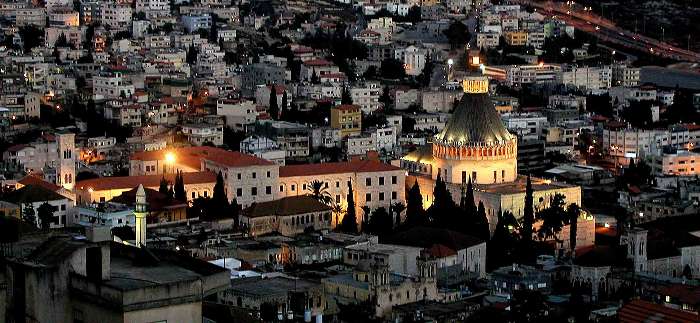
BTW - the picture above is of Nazareth, the biggest Arab town, where the center will be located.
How does it relate to event processing? Well- this launch is a big event, but like David Luckham's example of the stock market crash, it does not happen over a day, and consists of many smaller events. So - I'll blog in th future, about some of these smaller events that will happen. More -later; back to EP Blogging.